 close
- Productschevron_right
- Learningchevron_right
- Manufacturing solutionschevron_right
- Supportchevron_right


CoroThread® Mill 500
The next-generation orbital thread mill
- True flexibility — one tool covers a wide range of materials, applications, thread forms and sizes
- Exceptional reliability, ensuring process security in deep threads, long overhangs, difficult materials and unstable setups
- Superior tool life and productivity, supported by state-of-the-art coating technology and wear-resistant grades
Tool type
SolidWorkpiece material(s)
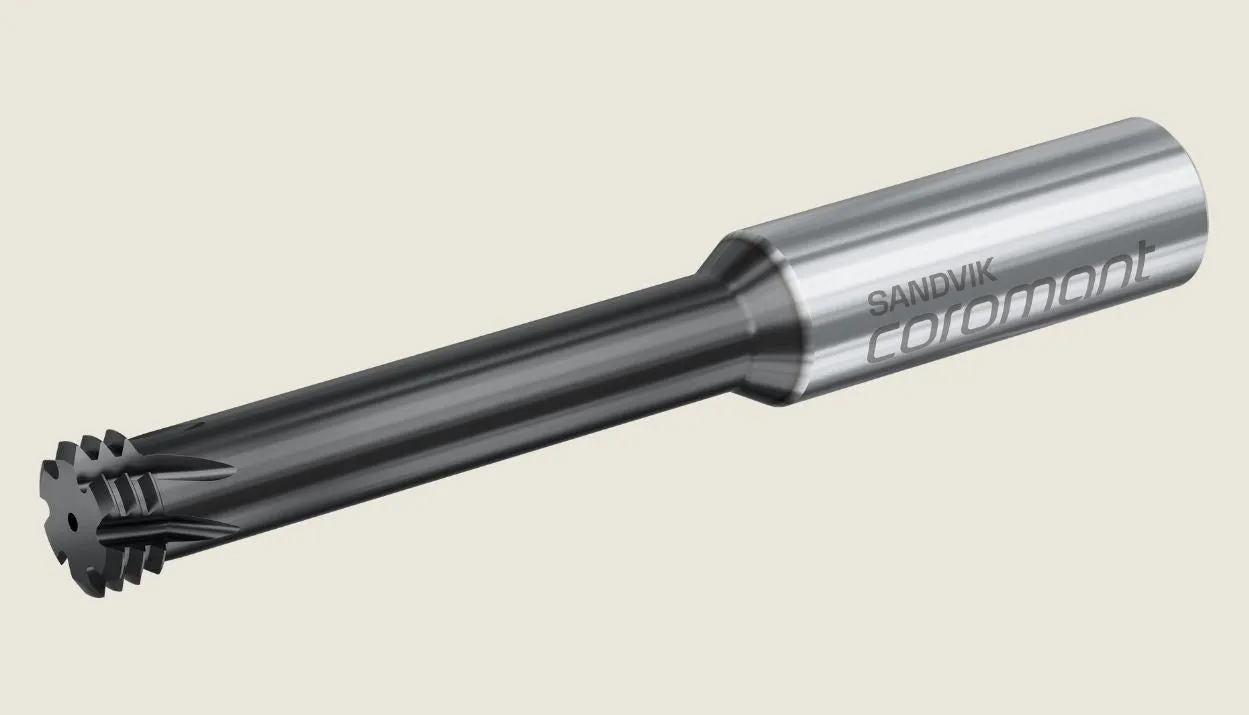
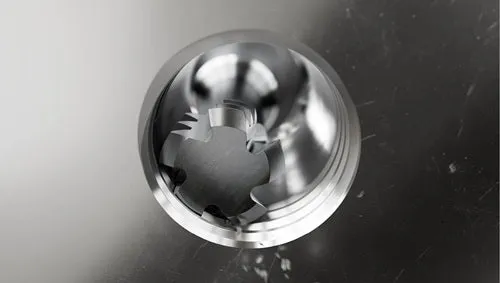
More productive thread milling
CoroThread® Mill 500 combines advanced coating and an optimized geometry to deliver unmatched tool life across materials and applications. Increase cutting feeds safely — without compromising quality.
With an optimized flute count and support for one-pass machining, it drives maximum productivity in every threading operation.
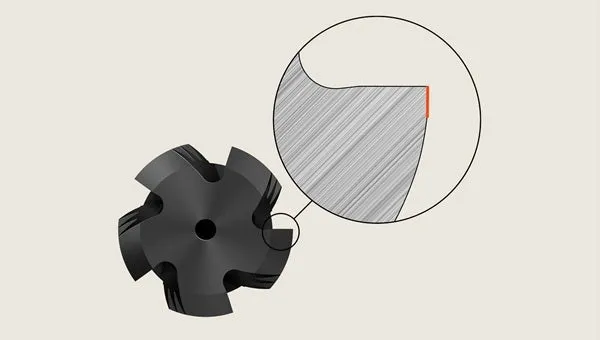
Chatter-free technology
Designed for chatter-free machining, CoroThread® Mill 500 minimizes vibration in long overhangs. It ensures excellent surface smoothness and improved thread quality, especially in deep threads, unstable setups, and difficult materials.
Available for 3×D and 4×D length variants.
Optimized programming, maximum thread quality
Use our optimized programming methodology supported by CoroPlus® Tool Guide and CoroPlus® Tool Path to maximize the performance of CoroThread® Mill 500. It improves thread quality, increases tool life and reduces the number of passes.

Product range
Thread mills
- Thread sizes: M1.2–M18
- Usable length: 2–4×D
- Thread forms: M, MF, MJ, UNC, UNJC, UNF, UNJF, EGUNF (STI)
- 4–6 flutes
- Internal coolant starts from M3, UNC#8-32
- External coolant starts from M1.2, UNC#1-64
- Chatter-free technology in 3–4×D
- Grades X1AH and X0AH
Application
- Internal threads in both blind and through holes
- Main industry segments: Aerospace, general engineering, automotive, medical and electronics
- Typical components: Engine casings, hydraulic blocks, cylinder heads, medical instruments and microscopes
- Workpiece material hardness: up to 48 HRC
Workpiece materials

Grades
Grade X1AH
- Versatile performance across a wide range of materials
- PVD coating
Grade X0AH
- Optimized for Ni and Ti alloys, ideal for aerospace components
- Available for EGUNF (STI), MJ, UNJF, UNJC
- PVD coating
Available as stocked standards and non-stocked standards.
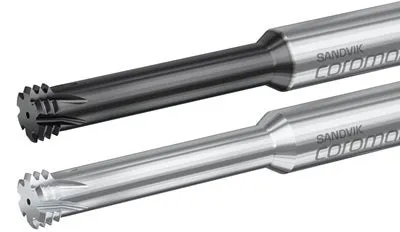
Assortment overview
| Thread forms | Ordering code start | Thread size | Usable length | Coolant type | Grade |
| Metric | T500-XM20Ax-Mx T500-XM30Ax-Mx T500-XM40Ax-Mx | M1.2–M18 | 2×D 3×D 4×D | External/Internal | X1AH |
| Metric fine | T500-XM25AE-MFxx | MF5–MF14 | 2.5×D | External | X1AH |
| Metric with rounded root form | T500-XM30Ax-MJxx | MJ3–MJ10 | 3×D | External/Internal | X0AH |
| UNC | T500-XM20Ax-UNCxx T500-XM30Ax-UNCxx | UNC 1–UNC 5/16 | 2×D 3×D | External/Internal | X1AH |
| UNC with rounded root form | T500-XM30Ax-UNJCxx | UNJC 4–UNJC 9/16 | 3×D | External/Internal | X0AH |
| UNF | T500-XM20Ax-UNFxx T500-XM30Ax-UNFxx | UNF0–UNF5/16 | 2×D 3×D | External/Internal | X1AH |
| UNF with rounded root form | T500-XM30Ax-UNJFxx | UNJF8–UNJF 9/16 | 3×D | External/Internal | X0AH |
| Extended gauge (STI) | T500-XM20AE-EGUNFxx | EGUNF10–EGUNF 3/8 | 2×D | External | X0AH |
New range versus previous generation
| CoroMill® Plura (R217) | CoroThread® Mill 500 | |
| Number of articles | 48 | 135 |
| Stocked/non-stocked | 48/0 | 69/66 |
| Thread forms | M, MF, UNC, UNF | M, MF, MJ, UNC, UNJC, UNF, UNJF, EGUNF |
| Thread sizes | M1.6-M12 | M1.2-M18 |
| Useable length | Up to 3×D | Up to 4×D |
| Coolant | External | Internal/External |
| Chatter-free technology | No | Yes M4-M18 (3×D) and M4-M16 (4×D) |
| ISO materials |  | |
Start by selecting one or more products
Start by selecting one or more products
Success stories
Customer case
Market: China
Component: Ring
Material: P5.0.Z.HT (P15), heat-treated low-alloy steel
Hardness: 380 HB
Operation: Threading 20 holes/part, 8 mm (0.315 inch), blind holes
Thread size: UNJF 3/8-24
Machine: Vertical multi-spindle machine
Tool holder: ER collet holder
Coolant: Emulsion 5–6%
Results
-59%
Cycle time
+400%
Tool life
Challenge: ISO P15 heat-treated low-alloy steels (P5.0.Z.HT) present demanding thread milling conditions due to high cutting forces, intermittent chip formation, and dominant wear mechanisms at the cutting edge. These challenges typically require multi-pass strategies to control load and wear, increasing cycle time and reducing process security.
Result: With CoroThread® Mill 500, the customer was able to perform the operation in one pass instead of three. Using the same table feed, they reduced cycle time by 59% and increased tool life by 400%.
Customer case
Market: Europe
Material: P3.0.Z.HT (P13), heat-treated alloy steel
Hardness: 380 HB
Operation: Threading 20 holes/part, 15 mm (0.590 inch) deep, blind holes
Thread size: UNJF 3/8-24
Tool holder: Hydraulic
Coolant: Emulsion 5–6%
Results
-48%
Cycle time
1.56
Saved hours
Compared with a competitor tool, CoroThread® Mill 500 reduced cycle time significantly. The customer completed the operation in a single pass instead of two, saving 1.56 hours on a batch of 20 parts.
Customer case
Market: Europe
Component: Side rail
Material: M1.0.Z.AQ (304L), austenitic stainless steel
Hardness: 183 HB
Operation: Threading 37 holes/part, through holes
Thread size: M4x0.7
Machine: Doosan DM 6700
Tool holder: Hydraulic
Coolant: Emulsion 5%
Results
+347%
Productivity
-78%
Cycle time
Unlike CoroMill® Plura (R217), CoroThread® Mill 500 required no radial adjustments, delivering a 347% productivity increase while reducing cycle time by 78%.
Customer case
Market: USA
Component: Test block
Material: P2.5.Z.HT (4140), heat-treated alloy steel
Hardness: 350 HB
Operation: Threading 540 holes/part, 22 mm (0.866 inch) deep, blind holes
Thread size: M6x1
Machine: Okuma MU-6300V-L
Tool holder: Hydraulic
Coolant: Emulsion 5–6%
Results
66
Minutes of tool life
Based on recommended cutting data from CoroPlus® Tool Guide, a stable single-pass strategy was applied with no wear offset adjustments throughout tool life. While the first two tools showed chipping between 90–180 holes, thread quality remained consistent. By introducing a CF collet on the third tool, chipping on the front tooth was eliminated — securing a more reliable and predictable tool life.
How to use
Thread milling versus tapping
Why thread milling?
- Higher process security, making it ideal for high-value components, difficult materials and deep threads
- Lower risk of component damage if the tool breaks
- Greater programming flexibility: easy adaptation of machining strategies and adjustment of radius compensation and thread tolerance
- Produces full bottom threads
- Lower cutting forces
- One tool for both through and blind holes, and multiple diameters with the same pitch
- Better chip control than tapping applications
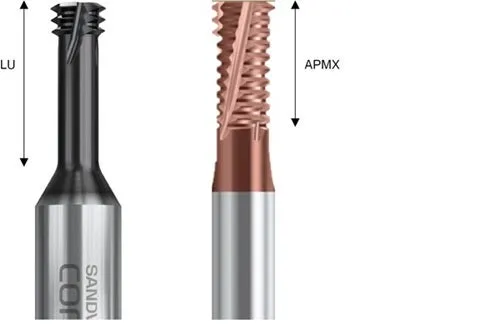
When to use an orbital thread mill over a full-toothed thread mill
- Both can use modified strategies or add additional radial passes
- Full-toothed thread mills can also be suitable if the designated thread length is within the APMX
| When to use an orbital thread mill | Benefits |
| Smaller thread sizes | To avoid overload during run-in, tools for small threads (M1.2, M1.8) are designed with only two cutting rows. As a result, even small threads can be machined reliably. |
| Deeper threads and difficult reach | Orbitals offer a better solution for deeper threads or features that require more clearance in the tool. |
| Difficult materials or applications | Lower cutting forces can be achieved compared to full-toothed thread mills. At extended lengths (3×D and 4×D), the XD geometry of the orbital threads provides a chatter-free feature to improve thread quality. |
Orbital thread mill versus full-toothed thread mill
Application recommendations
Cooling strategy
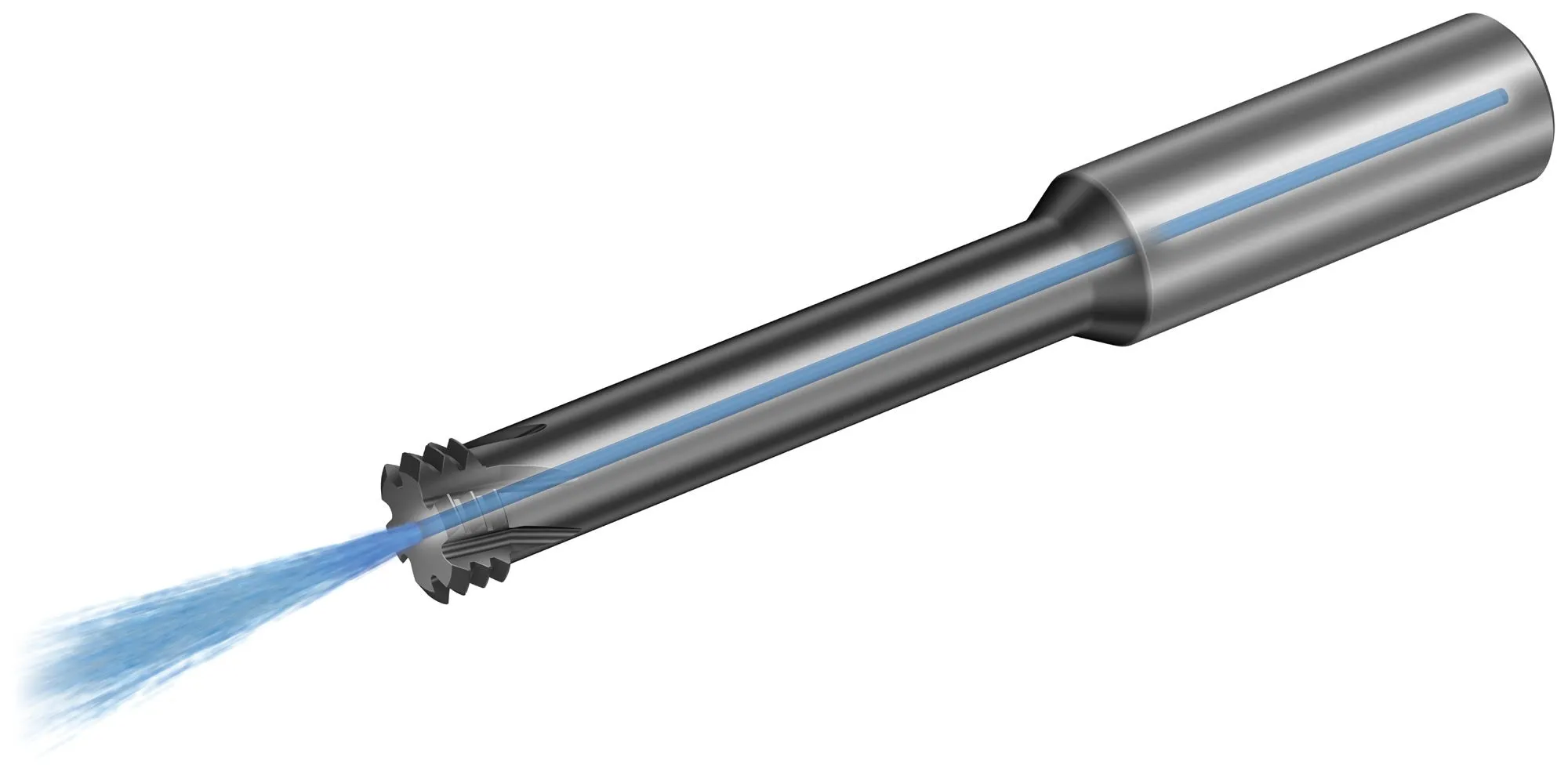
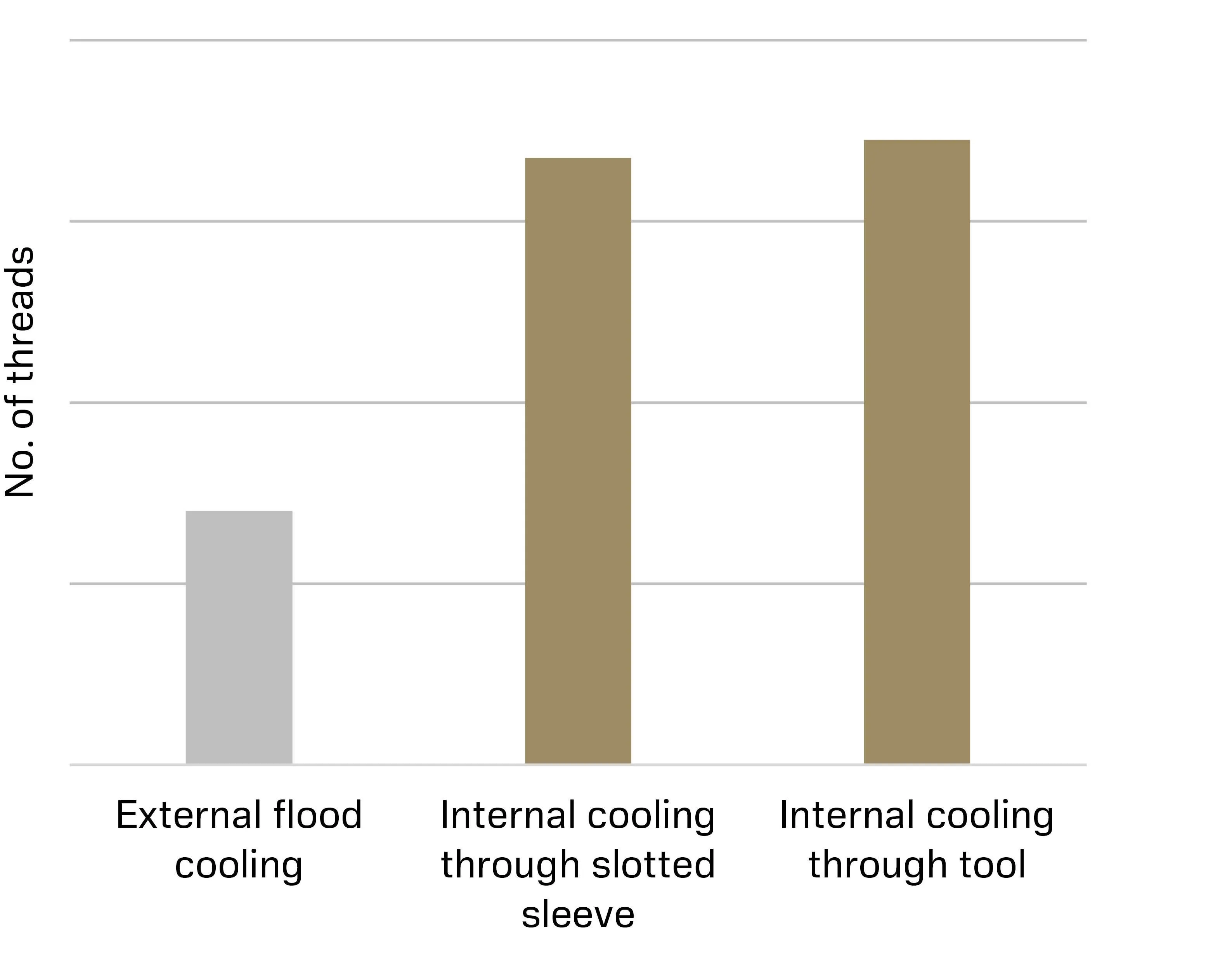
- Internal cooling through the tool: The most reliable option and becomes increasingly important as threads get deeper and dimensions get larger
- Cooling through the collet: The use of slotted collets or slotted sleeves (CF) gives similar results to a tool with internal cooling
- External flood cooling: The least favorable for deeper internal threads — it risks fractured front teeth, whereas internal cooling shifts wear to the working teeth where it's expected
Slotted collet (CF)
For external coolant
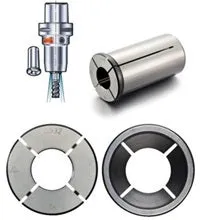
View our full range of CF collets here.
Tool life comparison
| Material | 42CrMo4–310 HB |
| Thread | M5–10 mm deep |
| Overhang | 3×D |
| vc, m/min (ft/min) | 60 (197) |
| fz, mm (inch) | 0.128 (2.36) |
| Strategy | Climb milling |
| Adaption | Hydraulic chuck AK182 |
Tool path fundamentals
Thread milling needs a machine capable of simultaneous movement in X, Y and Z:
- X and Y determine the thread diameter.
- Z controls the pitch — defined as the Z-axis movement per revolution.
- The thread is produced by circular ramping (helical interpolation).
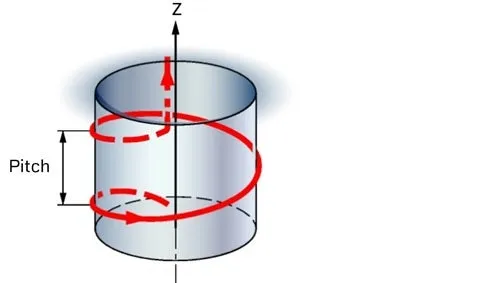
Climb versus conventional milling
- Preferably use down (climb) milling — it produces a favorable thick-to-thin chip
- Up (conventional) milling gives less tool deflection and can leave a better surface finish, but carries a risk of reduced tool life
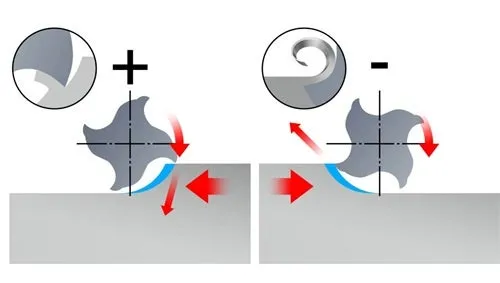
Down (climb) milling versus up (conventional) milling
Feed direction by thread type
The correct cutter direction depends on whether you're cutting internal or external threads and right- or left-hand threads, combined with climb or conventional milling.
Tool path: internal threading
| Right-hand threads | Left-hand threads | |
| Down milling (climb) | 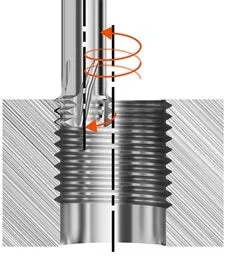 | 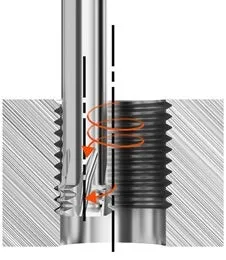 |
| Up milling (conventional) | 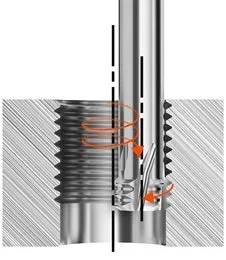 | 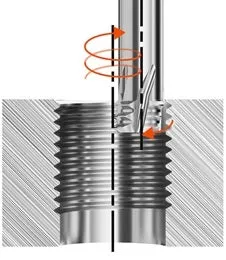 |
Entrance into cut
Enter the cut smoothly to avoid vibration and extend tool life — circular ramping makes this gradual engagement possible.
Program an extra circle on exit to ease the tool out of the cut and further protect tool life.
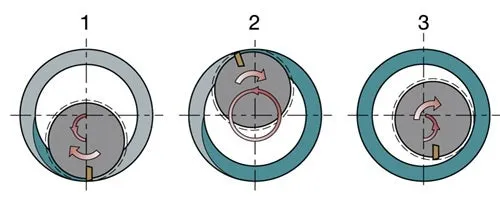
Programming strategy
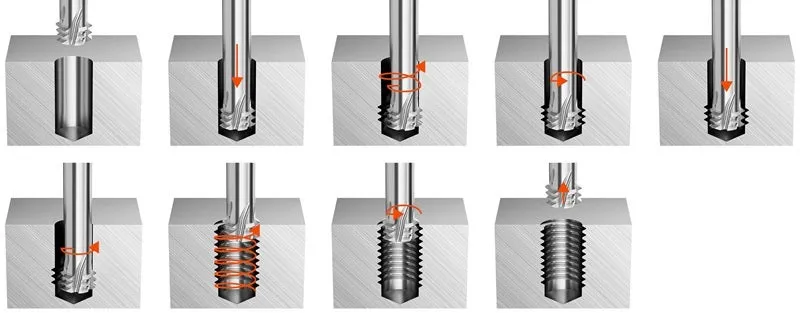
Recommended programming method
Access an optimized programming method through CoroPlus® Tool Guide and CoroPlus® Tool Path to achieve higher thread quality, longer tool life, and fewer passes.
NC programming and radius compensation
Use G41/G42 radius compensation to control thread tolerance:
- Every CoroThread® thread mill is marked with a radius programming value (RPRG) that indicates the cutter's exact pitch diameter and the radius compensation required.
- Enter the RPRG into the tool memory offset. Under good operating conditions, the first thread will never be cut oversized.
- Apply further radius/wear adjustments to fine-tune the thread gauge fit. (Note: newer machines reduce feed rate when radius compensation is active.)
Integrated programming: NC code generation for these strategies is available directly through CoroPlus® Tool Path, so the recommended roll-in, entry-loop and compensation logic is applied automatically.
Create account chevron_right
Place orders, view prices and check tool availability
Subscribe to our newsletter chevron_right
Join us. Stay updated.

Sandvik Thailand Limited
+66 2 016 2120 沪ICP备20012694号-1 京公网安备 11010502044395号51, JL Tower, 19th Floor, Room No. 1904-6, Rama 9 Road, Kwaeng Huamark, Khet Bangkapi
AB Sandvik Coromant, 811 81 Sandviken, Sweden